Log Splitter Drill Bit Review: The Honest Kindling Guide (2026)
The ad shows a drill punching a cone into a fat round, and the round pops in half in seconds. Owners on two firewood forums tell a different story: "Drive it into a decent sized solid chunk of wood and it just drills into a point where it stalls." But the same owners say a log sp
Log Splitter Drill Bit Review: The Honest Kindling Guide (2026)
The ad shows a drill punching a cone into a fat round, and the round pops in half in seconds. Owners on two firewood forums tell a different story: "Drive it into a decent sized solid chunk of wood and it just drills into a point where it stalls." But the same owners say a log splitter drill bit does one job well: turning small, dry softwood into kindling, if your drill has the muscle for it. Here is which bit to buy for that job, what drill it needs, and how to use it without the drill twisting your wrist.
Our verdict in one line: Buy it for the kindling bucket, not the woodpile. The 30mm cone bit (Rank #1) is the cheapest way to try that job, if you own a strong corded or hammer drill.
How we picked: We did not test these tools by hand. We judged six products from their supplier listings, listing images and owner reports on OPEforum and the Pitmaster Club. We also used toolzguru's buying guide and Milwaukee's advice on drill kickback. Every price below is the price on the product's buy card.
I keep a kindling bucket next to the wood stove. Each fall I split pine offcuts and small, dry, straight pieces into fire-starter sticks. That is the job every tool here gets judged against. My other test is simple. Will this one end up in the junk drawer?
What the Ads Show vs What Owners Report
The ads promise rounds split "in seconds." The owners who bought one describe something smaller and more useful.
- Rounds: One OPEforum owner put it plainly. For "real firewood size pieces it's probably not going to work the way you envision."
- Size limits: Another called it "very limited to 2" or less pieces, softer wood only."
- Wood type: A Pitmaster Club member warned the wood must be "straight grained, and dry as all get out."
- The upside: Owners also say it works on small stuff to make kindling.
So the honest job is narrow. You take a piece that is already small, dry and soft, and crack it into sticks. It is not a way to retire your maul.
Who Should Not Buy This
Skip a log splitter drill bit if any of these fit you:
- You want to split rounds or hardwood. Owners report the cone drills in and stalls. Use an axe, a maul or a hydraulic splitter.
- You only own a cordless drill/driver. Owners say those struggle. More on that below.
- You won't clamp or secure the wood. A spinning cone in a loose piece is how wrists get hurt.
- You want kindling but no power tool. Jump to Rank #5 or Rank #6. They need no drill at all.
What Drill Do You Need?
This is the question that decides whether a log splitter drill bit works for you. It comes down to torque, the twisting force a drill can put out.
toolzguru gives a rough floor. Smaller bits need a drill of at least 500W. Larger bits need drills "rated above 750W." One owner wrote that his Milwaukee M18 cordless drill "was unhappy with the power needed, even in low range." A Pitmaster member was blunter: "Great way to wear out your drill and toast your batteries."
Here is the plain-words version:
- Cordless drill/driver: Light and handy, but low on steady strength. Owners say it is the wrong tool here.
- Corded drill with a side handle: A realistic match for a small cone.
- Rotary hammer: The big drill in the videos. As one member said, "notice the size of the drill he was using."
Then check the shank. SDS is a slotted shank that locks into a hammer drill's chuck. A regular three-jaw chuck grips round or hex shanks. Not every listing says clearly which one you get.
Safety First: How to Avoid Kickback
Kickback is when the bit snags and the drill body twists instead. Milwaukee's guidance says it happens when the motor lacks the power for the job, or when the bit is inferior. A cone bit in a stubborn piece is exactly that setup.
Follow these rules every time:
- Use the side handle. Milwaukee's advice: "use your handle, keep two hands on the drill."
- Secure the wood. Clamp it or wedge it so it cannot spin with the bit.
- Start at the edge. toolzguru says to start from the wood's edge and not force the bit.
- Don't force it. If the cone stalls, stop. Back it out and pick a smaller piece.
- Inspect and tighten. Check "that the bit is properly tightened" and look for damage before use.
- Wear goggles and gloves. toolzguru lists both as basic gear.
If that list sounds like more than you want near your hands, the manual tools at Rank #5 and #6 skip the risk.
Comparison Table: 6 Kindling Tools Side by Side
Here is how each log splitter drill bit and no-drill option compares on price, cone size and fit.
| Rank | Image | Model Name | Key Spec | Best For | Value | Quick Buy |
|---|---|---|---|---|---|---|
| 1 |  | 30mm cone wood-splitting drill bit, single bit | 30mm cone, fixed shank (listed "Round") | Kindling with a strong corded or hammer drill | $25.99 | |
| 2 |  | 32mm cone wood-splitting bit with 4 interchangeable shanks | 32mm cone, 4 screw-in shanks | Buyers unsure of their chuck | $27.99 | |
| 3 |  | 32mm or 42mm cone splitting bit, choice of round, square or hex shank | Pick shank and size at order | Buyers who know their drill | $28.99 | |
| 4 |  | Cone splitting bit for hammer drills, small or large | Built for hammer drills, SDS-type look | Rotary hammer owners | $26.99 | |
| 5 | 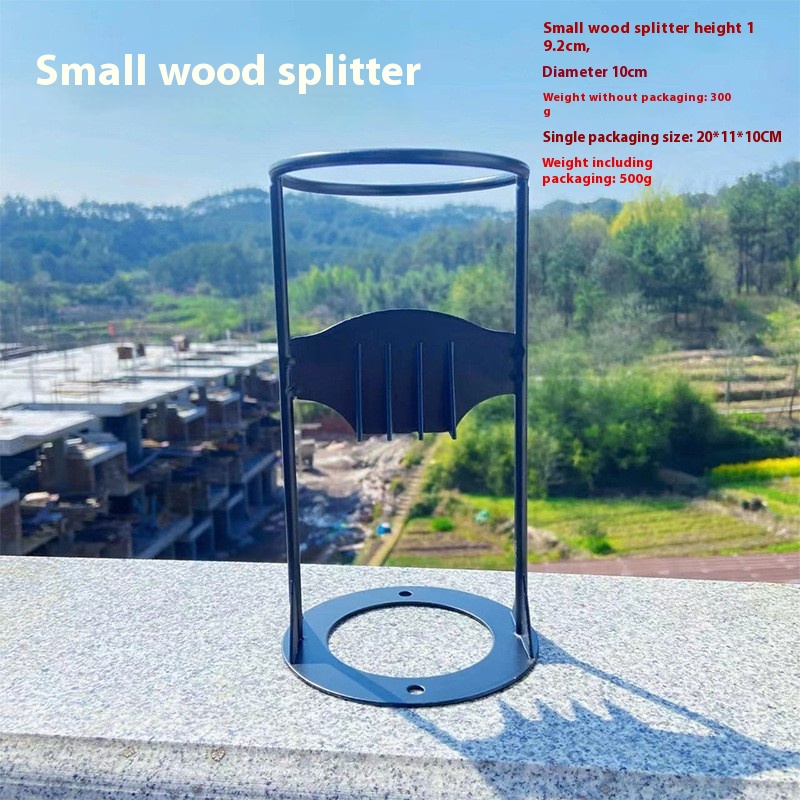 | Cage-style manual kindling splitter, small | No drill, guard ring, 10cm opening | Kindling with no power tool | $32.99 | |
| 6 |  | Mini cast-iron splitting wedge base, small | No drill, open wedge, 10 x 7cm | Camping and fire pits | $27.99 |
The Best Log Splitter Drill Bits and No-Drill Alternatives, Reviewed
1. 30mm Cone Splitting Bit: Best Overall for Kindling
Key spec: 30mm cone, 67mm threaded section, 145mm overall. Price: $25.99.
Drill demand. This is the smallest cone in the ranking. The listing image labels a 30mm diameter, a 67mm threaded cone, a 28mm collar and a 145mm overall length. A smaller cone asks less of the drill. That lines up with toolzguru's rule that small bits need about 500W and large ones need more than 750W. It still needs a strong drill, just the least of any cone here.
Shank fit. This is the weak spot. The variant is labeled "Round," but the image shows a slotted shank that looks SDS-type. The listing does not confirm which drills it fits. Look at your chuck before you order. If you own a three-jaw chuck, see Rank #2.
Kickback and hands. It is a drill-driven cone, so every rule in the safety section applies. It still needs the side handle, two hands and clamped wood.
Price and value. At $25.99 it is the cheapest item in this guide. You get one bit and one fixed shank. Supplier stock sits at 29,529 units for this variant, and US delivery runs 5-11 days. For the junk-drawer test, this is the lowest-cost way to learn whether the kindling job suits you.
Pros
- Lowest price here, at $25.99
- Clear dimensions on the listing image
- Smallest cone, so the lowest drill demand of the cone bits
- Owners say this type of bit works on small pieces for kindling
Cons
- One fixed shank, no spares in the box
- Shank type is not stated in text, so it may not fit a cordless chuck
- Stalls in large or solid pieces, like every cone bit
Verdict: The best log splitter drill bit here for the kindling bucket, as long as your drill takes its shank and has the strength to turn it.
30mm cone wood-splitting drill bit, single bit
2. 32mm Cone Bit with 4 Shanks: Best If You're Unsure of Your Chuck
Key spec: 32mm cone with four screw-in shanks. Price: $27.99.
This bit answers the "will it fit my drill?" worry. The listing image shows four shanks: two slotted SDS-style, one hex and one quick-change hex. That covers more chucks than any other bit here, for $2 more than Rank #1. Sizes run up to 50mm, but pick the 32mm cone for kindling.
The catch: the hex shank tempts you to grab a cordless drill, and owners say those lack the strength. Treat the hex shank as a fit option for a corded drill, not a reason to go cordless. The threaded joints also add a spot where play can creep in. toolzguru's advice applies twice here: make sure the bit is properly tightened.
Pros
- Four shanks cover SDS, hex and quick-change chucks
- Sizes from 32mm to 50mm on one listing
- Only $2 more than Rank #1
Cons
- Kindling and small softwood only, like every cone
- Hex shank invites cordless use, which owners say fails
- Screw-in joints need checking before each session
Verdict: The safest log splitter drill bit to order when you don't know your chuck yet.
32mm cone wood-splitting bit with 4 interchangeable shanks
3. 32mm/42mm Cone Bit, Pick Your Shank: Best If You Know Your Drill
Key spec: 32mm or 42mm cone, round, square or hex shank chosen at order. Price: $28.99.
Know your chuck? Buy the right shank once. The image key names each option. A, B and C are the 32mm cone with a round, square or hex shank. D, E and F are the 42mm cone. A "Set" option also exists. Stock sits at 40,000 per variant.
That key is also the risk. The letters are decoded only in the listing image, so it is easy to order the wrong one. Read the image twice. Pick the 32mm cone unless you own a strong corded drill, since the 42mm size falls into toolzguru's "larger bits" group. At $28.99, it is the priciest of the single-cone options.
Pros
- Names each shank type and size, clearer than Rank #1
- 32mm and 42mm cones on one listing
- Large stock
Cons
- Variant letters A-F are easy to mis-order
- Highest price of the single-cone bits
- Same kindling-only limits owners report
Verdict: Buy it when you know your chuck and want no spare shanks.
32mm or 42mm cone splitting bit, choice of round, square or hex shank
4. Hammer-Drill Cone Bit: Best for Rotary Hammer Owners
Key spec: Cone bit for hammer drills, small or large. Price: $26.99.
This listing is the only one that says outright it is meant for a hammer or percussion drill. The image shows a slotted, SDS-type shank next to a rotary hammer. That matches the owner advice to "notice the size of the drill he was using."
The listing is loose on details, though. The small and large sizes carry no stated diameters. The A, B and C options are not explained in text. The shank type is only implied by the photo.
Pros
- Built for the big drill owners say you need
- Only $1 more than Rank #1
Cons
- No stated diameter or shank in the text
- A/B/C options not explained
- Same kindling-only limits and kickback risk
Verdict: A sensible log splitter drill bit if you own a rotary hammer and accept vague sizing.
Cone splitting bit for hammer drills, small or large
5. Cage-Style Manual Kindling Splitter: Best No-Drill Pick
Key spec: Steel cage over a fixed blade, 19.2cm tall, 10cm opening, 300g. Price: $32.99.
No big drill? Skip the bit and get the cage. This tool answers the "will it kick back?" worry by removing the motor. You set a piece inside the steel ring and tap it down onto the fixed blade with a mallet. There is no chuck question and no spinning tool near your hands. Pitmaster Club members pointed to this manual format as the safe and easy choice for kindling.
The 10cm opening caps piece size, so this is kindling only. You need a mallet or hammer, which the listing does not include, and a solid base. At $32.99, it costs more than any cone bit, but needs no bigger drill.
Pros
- No drill, no kickback, no fit question
- Guard ring keeps the blade inside the cage
- Height, opening and weight stated on the listing
Cons
- Priced above the cone bits
- 10cm opening limits piece size
- Needs a mallet and a solid base
Verdict: The pick for anyone whose real job is kindling and who wants no power tool involved.
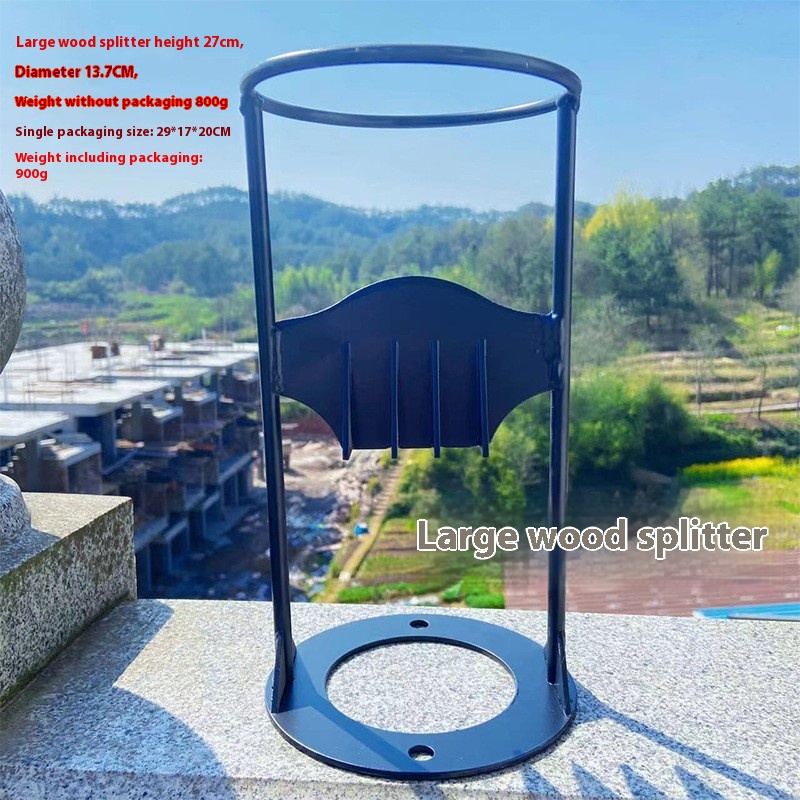
Cage-style manual kindling splitter, small
6. Mini Cast-Iron Wedge Base: Best for Camping and Fire Pits
Key spec: Cast-iron wedge on a flanged base, 10 x 7cm. Price: $27.99.
The simplest tool here is a small cast-iron blade on a base with holes, about 10cm wide and 7cm high per the listing image. The holes suggest you can screw it to a stump or board.
Compare it with Rank #5 before you buy. The wedge is an open blade with no guard ring around it. You still need a striking tool and a stable mount.
Pros
- No power tool involved
- Compact and portable
- Base holes for fixing it down
Cons
- Open blade, no guard ring
- Small kindling pieces only
- Needs a striking tool and a firm mount
Verdict: Best for campers who want a tiny kindling tool and will mount it firmly.
Mini cast-iron splitting wedge base, small
How to Choose a Log Splitter Drill Bit
Use these four checks, in this order.
- Match cone size to your drill. Smaller cones ask less. A 30mm or 32mm cone is the realistic pick for a corded drill. Save 42mm and up for a strong machine.
- Match the shank to your chuck. SDS for a rotary hammer. Round or hex for a three-jaw chuck. Unsure? Get the four-shank bit.
- Decide bit or manual tool. If you have no strong drill, or don't want one near your hands, a cage splitter does the same kindling job.
- Match the wood. Small, dry, straight-grained softwood. Owners say pieces around 2 inches or less work. Wet or knotty hardwood will stall any cone.
A firewood splitter drill bit costs little. The drill it needs may not.
FAQ
Will a log splitter drill bit split full firewood rounds?
Realistically, no. Owners say the cone drills in and stalls in solid, full-size pieces. One calls it "very limited to 2" or less pieces, softer wood only." Treat it as a kindling maker. For rounds, use an axe, a maul or a hydraulic splitter.
Can I use it with my cordless drill?
Owners say cordless drills struggle. A Milwaukee M18 "was unhappy with the power needed, even in low range." A corded drill or rotary hammer with a side handle is the realistic match.
Will it fit my drill's chuck?
Check the shank first. Rank #1's image shows a slotted, SDS-style shank, but the listing only says "Round." If you're unsure, Rank #2 includes four screw-in shanks. Rank #3 lets you pick round, square or hex when you order.
Is it dangerous? Can it twist my wrist?
It can. Kickback happens when a bit snags or the motor is underpowered, per Milwaukee. Follow the safety rules above. If you want no spinning tool near your hands, pick Rank #5 or #6.
Is it just a gimmick that ends up in a drawer?
For people who bought one to replace an axe, often yes. One owner's bit sits in his "random junk I have no other place for" drawer. Owners also say it works well on small stuff for kindling. Buy it for that job, with a drill that can turn it, and it earns its keep.
Final Verdict
Buy the 30mm log splitter drill bit (Rank #1, $25.99) for the kindling bucket if you own a strong corded or hammer drill and will clamp the wood. Get the four-shank bit (Rank #2) if you aren't sure of your chuck. If you have no big drill, get the cage splitter (Rank #5) instead. And keep the axe for rounds.